
How to Search the Brazos County Court Docket
Start at Brazos County Judicial Records Search, the local gateway most people call Justice Web. Two tools live inside it. Smart Search pulls up cases and judgments, while Search Hearings covers calendar events. Before typing anything, check the paper that brought you here. A citation, pleading, notice, or order names the court you need. Brazos County assigns different clerks to city citations. Other clerks handle JP causes, County Court at Law matters, and District Court cases.
Have your details ready. Gather a party or business name, case or cause number, court, case type, and a rough filing or hearing date. Numbers beat names for precision. Justice Web also warns that a session can expire after 60 seconds, so preparation matters.
- Open the county portal and choose Smart Search for a case or Search Hearings for a setting.
- Enter the exact record number, or search a person in Last, First Middle Suffix order. Choose Business Name for an entity.
- Narrow by location, case type, status, filing dates, judicial officer, hearing type, courtroom, or hearing dates.
- Read the case, judgment, or hearing result as a finding aid and note the assigned court.
- Ask the responsible clerk for inspection, a plain copy, or a certified record when the portal does not supply the item.
Brazos County Justice Web Paths
The two Justice Web tools answer separate questions. Smart Search takes a record number or a name. It can cover both Cases and Judgments. Its advanced panel lets you narrow by location, search type, case type, status, file dates, judicial officer, judgment type, and judgment dates. Search Hearings works differently. It is built around location, hearing type, search type, criteria, officer, courtroom, and a date range.
| Portal path | Key fields | Best use |
|---|---|---|
| Smart Search | Record number, name, business, case type, status, dates | Locate a case or judgment |
| Search Hearings | Location, hearing type, criteria, officer, room, date range | Find a past or future setting |
| re:SearchTX | Cases, filings, document text, hearings, filters | Separate statewide check |
The official Justice Web landing page shows the public gateway and its access notice.
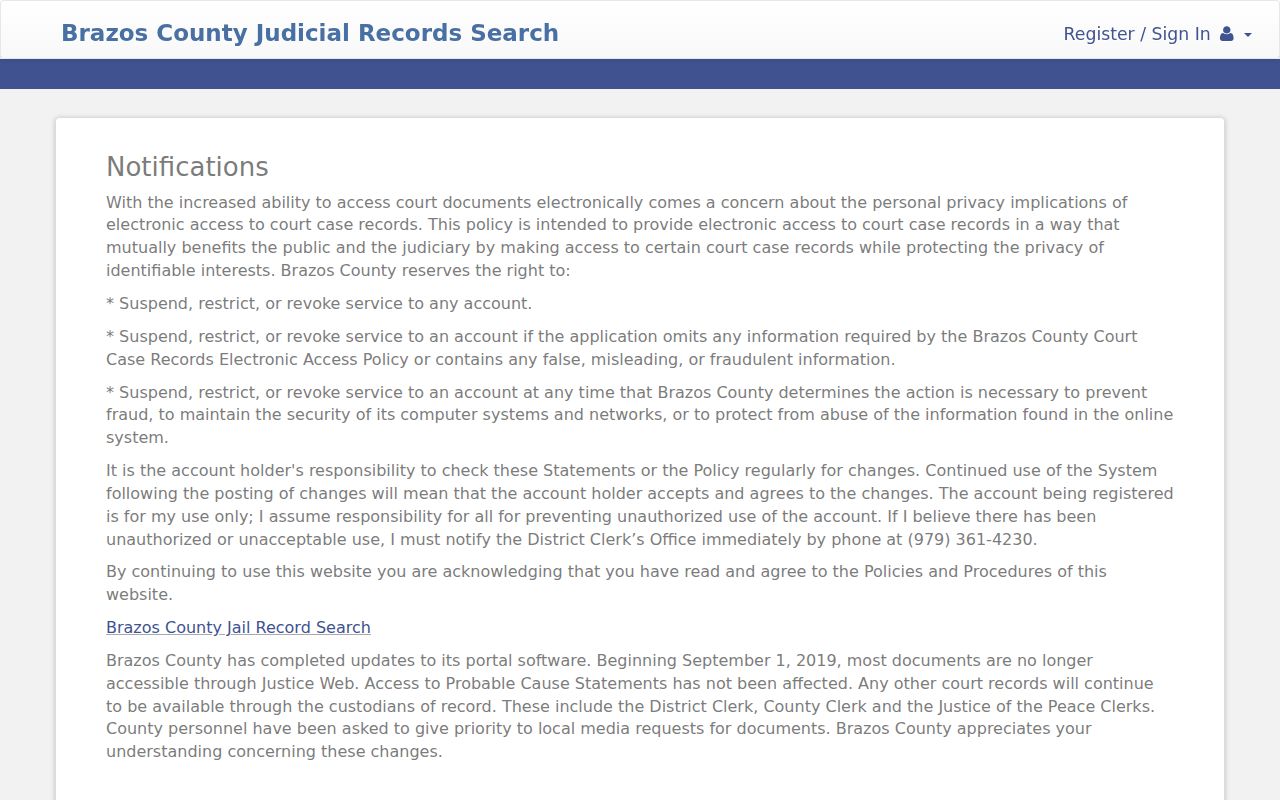
One quiet benefit deserves mention. You can open the blank interface and learn its routes without typing a private name, birth date, booking identifier, or allegation into anything. Exploring the form costs nothing.
What a Court Docket Shows
Think of a court docket as an index, not a story. It lists the court, the parties, filed items, settings, and current status. It is not the full text of every document. Nor is it a live transcript or proof that an allegation was established. Brazos screens also draw lines between a case, a judgment, and a hearing. Read each entry for what it actually is.
| Case or Cause Number | The court-assigned identifier. Formats vary by court, so preserve all letters, zeros, and marks. |
|---|---|
| Parties | Names indexed to the matter, subject to privacy and access limits. |
| Filings and Entries | Dates and descriptions of items placed in the record. |
| Hearing Settings | The event type, date, room, officer, and other calendar fields available. |
| Court and Judge | The assigned court or judicial officer shown by the source. |
| Disposition or Status | The recorded result or current state, which should be checked against a signed order. |
A search hit is not a promise of a downloadable file. For an authenticated judgment, indictment, order, or docket sheet, the clerk's record remains the source.
Brazos County Docket Document Line
Justice Web states that beginning September 1, 2019, most documents stopped being accessible. The portal is the piece that changed. Probable Cause Statements are the stated exception. Everything else sits with the District Clerk, County Clerk, or JP clerks. Remember, the limit concerns online delivery only, not whether a case or record is public.
Search result versus case file: A case may appear in Justice Web while its pleadings, orders, or exhibits must be requested from the custodian.
"Not visible online" does not prove a document is sealed. It may simply sit outside the portal, belong to another clerk, require redaction, or fall under a statute, rule, or order. When you ask, name the exact record by court, number, type, and date range.
Which Courts Keep Dockets
Brazos County runs four court levels, plus state appellate and federal routes. So the first question is always which court owns the matter. The courthouse address alone will not answer that, because several courts and clerks share one building.
| Court | Docket covers | Starting channel |
|---|---|---|
| 85th, 272nd, 361st, 472nd District Courts | Felonies, family, juvenile allocations, and general civil work | Justice Web and District Clerk |
| County Courts at Law 1 and 2 | Misdemeanors, civil, probate, family, condemnation, appeals | Justice Web, Today’s Docket, assigned clerk |
| Justice Courts 1 through 4 | Small claims, civil up to $20,000, evictions, Class C, traffic | Named JP clerk and county tools |
| Bryan and College Station Municipal Courts | City ordinances and state Class C matters | City court, docket, or citation channel |
| Tenth Court of Appeals | State appeals from its Brazos service area | Waco-based appellate court |
| Southern District of Texas | Federal cases assigned to the Houston Division | PACER and federal clerk, not a Bryan federal court |
One county overview says three district courts while listing four. Current direct pages and directories support the number four. The 472nd was created in 2023, a sign of local court growth rather than a live caseload count.
Brazos County Docket Custodian Split
The custodian split is simple on paper. The District Clerk keeps district civil, family, juvenile, and felony criminal cases. It also keeps the misdemeanor filings the county describes. The County Clerk handles county-court civil, probate, guardianship, mental-health, and official-record functions. JP clerks keep JP files. Municipal clerks keep city cases.
In practice it can look odd. County Court at Law pages describe misdemeanor jurisdiction. Yet the District Clerk page says misdemeanor filings and documents are its responsibility. Some county-court civil and probate instructions point back to the County Clerk. Start from the case type and assigned court, then confirm the custodian. Note that the County Clerk's OCR-enabled official-records search covers deeds and indexed official records. It does not cover the judicial docket.
Finding Court Dates and Settings
When the question is a date, use Search Hearings. It wants location, hearing type, search type, criteria, judicial officer, courtroom, and dates from and to. County Courts at Law 1 and 2 also post official Today's Docket links. CCL2 lists weekly jury trials. It also posts associate misdemeanor dockets on Tuesday and Thursday mornings and Wednesday afternoons. Each date still needs a current check, though.
Municipal schedules stay separate. College Station's docket interface uses labels such as FTA Show Cause, Jail Arraignment, Non Contested, and Pretrial. Bryan links to a weekly docket that may load slowly. A missing date is never a dismissal. Check a later order. Call the clerk. You can also use the Brazos County court calendar process for resets and missed settings.
Brazos County Docket Terms
Local pages lean on short labels. Knowing what each object is keeps a case search from being mistaken for a hearing search or a final result.
- Cause number
- The identifier assigned by a court to a case.
- Today’s Docket
- A court-specific current schedule page.
- Setting
- A hearing or event placed on a court calendar.
- Disposition
- The recorded resolution or status of a case or event.
- Continuance
- A delay or rescheduling of a setting.
- Certified copy
- A copy authenticated by the custodian, usually for a fee.
Payment and filing are separate things too. eFileTexas receives filings and service, but it is not the public docket. A county payment page handles balances, not the price of a record search or certified copy.
Public Access to Dockets
Texas court records do not fall under one blanket Public Information Act instruction. Instead, case records answer to common law, statutes, court rules, orders, and the responsible clerk. Certain non-adjudicative judicial records fall under Rule of Judicial Administration 12.
Key Texas access rules:
Rule of Judicial Administration 12 supplies a public-access process for certain judicial records, with exclusions and an appeal path.
Texas Rule of Civil Procedure 21c requires care with sensitive data in filed documents.
Texas Rule of Civil Procedure 76a governs sealing of court records.
Texas Family Code chapter 58 addresses juvenile confidentiality and sealing.
A response can take several forms: a full or redacted copy, an inspection appointment, a fee estimate, a referral, or a denial with an explanation. OCA does not decide a local clerk's case-record denial. Ask the custodian about the process for that specific record.
Brazos County Docket Privacy Boundaries
Juvenile cases do not look like an ordinary public case. The same goes for sealed records and protected parts of family files. The 272nd District Court hears juvenile matters. But that assignment does not make juvenile information open. Rule 21c sets privacy treatment for sensitive items. Account numbers, birth dates, home addresses, government identifiers, and minors' names are on that list. A blank result has other causes. Spelling slips hide cases. So do the wrong court, date filters, indexing gaps, and the 2019 Justice Web limit. A portal screen proves nothing about sealing. So do not label a file sealed from that screen alone. Also avoid copying private fields into search examples or screenshots. A narrow request uses the case number, court, record type, and date range. That keeps out extra personal data.
The Clerk and Docket Records
The District Clerk keeps the District Court dockets. Its county page also states the criminal and civil duties. Access comes several ways. Justice Web is one. A printable request can travel by mail, fax, or email. An online public-information form, in-person delivery, pickup, and on-site inspection are also options. A phone call confirms the right court, room, record, and current charge.
Brazos County District Clerk
300 E 26th Street, Suites 1200/1201
Bryan, TX 77803
(979) 361-4230
Fax: (979) 361-0197
Email: dcsearches@brazoscountytx.gov
The printable form offers pickup, US mail, and on-site inspection. Searches generally cover criminal and civil records from 1992 to present. You can request another range. Probate and similar county-court records sit with the County Clerk, at (979) 361-4128. JP and city records belong to their own clerks.
Brazos County Docket Copy Costs
The District Clerk's request form lists a $5 search fee, $1 per copy page, and $5 per certified document. The separate fee page differs. It prices certification at $5 plus $1 per page; confirm the total before mailing payment.
| Request item | Published amount | Check before use |
|---|---|---|
| Record search | $5 on request form | Date range and office |
| Plain copy | $1 per page | Page count and delivery |
| Certification | $5, with page charge described separately | Current clerk calculation |
Per the form, processing or evaluation starts once payment arrives. Cash works in person only. Checks and money orders are accepted too. These are record-request terms, not court filing fees, service fees, or payments on a case balance.
Brazos County Historic Docket Leads
Modern cases live on Justice Web. Older Brazos County court records live elsewhere. The District Clerk's linked Kofile page holds remote index books. Civil Minutes run from the 1800s through 2000, and Criminal Minutes cover 1874 through 1999. There is also a Criminal Fee Book, 1986 through 2001. A Divorce Index covers 1965 through 2000. Divorce Minutes run 1897 through 1973.
Genealogy and historical case research benefit from these books. Yet an index is not a full file. Write down the series, book, year, and entry. Then ask the District Clerk what can be inspected or copied. Brazos County's court geography has shifted over time. Bryan has been the county seat since 1866. The 472nd District Court was added in 2023, so do not force old context onto a current court assignment.
One old name may need more than one finding aid. Pick the series that fits the record and period. Record the book reference. Then ask whether the office offers inspection, a plain copy, or certification. An old volume may point to minutes rather than every paper once filed. That distinction matters. It keeps an index lead from being mistaken for a complete modern docket. It also spares the clerk extra personal details.
Use the archive and the live portal in order. Start with Justice Web for a modern case. If the event falls outside that online span, choose a Kofile series by record type and year. A divorce index is a pointer. Divorce minutes preserve a different kind of court record. Criminal fee books do not stand in for criminal minutes. Once a likely entry turns up, give the District Clerk the book, date, name, and record type. Ask the office to state whether the item exists, where it is held, and what copy method is available. This keeps old Brazos County docket sources useful and prevents a false no-result when a modern name search cannot reach the older series.
Historical place names need the same care. Boonville was an early county seat. Bryan became the seat in 1866, and the railroad reached Millican in 1860. Those facts explain why an old reference may name a place missing from today's court map. They do not create a present municipal docket or move records to a new office. Use the record's date to pick the source. Then let the current clerk verify what survives.
Court Dockets by City in Brazos County
City identity, incorporated status, and court jurisdiction are three different things. Bryan and College Station have current municipal-court pages and OCA listings. Kurten runs an active city site. Yet the OCA directory lists no Kurten municipal court. Wixon Valley is another gap. It appears in neither the municipal directory nor the activity report. Millican has deep historic roots. But that old incorporation history does not prove a current municipal court.
College Station Court Docket
Municipal citations, city Class C cases, settings, payments, and an upcoming docket interface.
Bryan Court Docket
Municipal Court of Record for city ordinances and state Class C matters, with a city docket route.
Kurten Court Docket
Active city government, but no municipal court found in the inspected OCA directory; follow the issuing court.
Wixon Valley Court Docket
Official place geography does not identify a docket; begin with the court named on the citation or case.
Millican Court Docket
Historical place and incorporation sources do not establish a current municipal docket; use the named custodian.
For any county-level matter tied to a place, search Justice Web or contact the District, County, or JP clerk. A map label alone names no court.
Map and Directions to the Brazos County Courthouse
District Court felony criminal, family, juvenile, and civil cases over $500 are filed and kept at the Brazos County Courthouse, 300 E 26th Street, in downtown Bryan. The District Clerk's office sits in Suites 1200/1201. Other courts and clerks share the same building at different suites — the County Clerk in Suite 1430, the 85th District Court in Suite 440, the 272nd in Suite 400 with courtroom 409, and the 472nd in Suite 2614 — and directory listings do not always match a court's own page, so confirming the current suite before a visit avoids a wrong-floor trip.
Brazos County District Clerk
300 E 26th Street, Suites 1200/1201
Bryan, TX 77803
(979) 361-4230
Monday through Friday, 8:00 a.m. to 4:30 p.m.
The county's official pages give department addresses and hours but no single visitor guide for parking, entrance screening, or an ADA route, so calling the clerk or checking the current county directory before arriving helps confirm the room and suite for the assigned court.