
How to Search Criminal Dockets
Start at the Brazos County Judicial Records Search. It is the county's official portal, also known as Justice Web. Smart Search works best for tracking down a case or judgment. Search Hearings is the better tab for a date. It also covers courtroom, hearing type, or judge. A cause number beats a name almost every time. With only a name in hand, check the court, file date, case type, and status side by side. Only then should you trust a match as the right case.
- Identify whether the matter is a felony, misdemeanor, fine-only Class C case, or city ordinance case.
- Search the cause number in Smart Search, or enter the name in last, first, middle, suffix order.
- Open advanced filters and narrow by case type, status, filing date, judicial officer, or judgment fields when needed.
- Check Search Hearings separately if the target is a setting.
- Request the docket sheet or named filing from the correct clerk when the portal gives only an index entry.
The portal is not the only route. The District Clerk takes written public-information requests online or on paper. Availability questions go to (979) 361-4230. Walk-ins are served at the counter in Suites 1200 and 1201. Mail and fax requests go through the official form. Registered users can also pull filings through re:SearchTX, a separate statewide tool. Coverage there depends on which courts take part, so document access varies.
Note: Justice Web sessions may expire quickly, so gather the cause number, spelling, date range, and court level before searching.
Brazos Portal Document Boundary
The county's own Justice Web explanation marks a sharp line. One side is spotting a case. The other is reading its documents. Most documents have been off limits through Justice Web since September 1, 2019. That is what the notice states. Probable-cause statements are expressly exempt from that cutoff. Even so, one statement is not the whole Brazos County criminal case file.
A docket hit may index the case, judgment, or hearing. Meanwhile the indictment, plea papers, orders, and judgment text stay unavailable online. Ask the clerk's office for the specific item by name. The District Clerk request form lets you choose an entire case, a final judgment, an indictment, or another named record.
Portal hit versus court file: A search result is a locator. A clerk-produced docket sheet or copy is the record to use when the exact filing, disposition, or certification matters.
What a Criminal Docket Shows
Think of a Brazos County criminal docket as a running log of events. It ties the cause number and assigned court to filings, hearing settings, motions, pleas, orders, judgment details, and disposition entries. The portal splits results into Cases, Judgments, and Hearings tabs. So one screen rarely holds the full history. Read each label in context. When the wording could affect a deadline or an outcome, verify the underlying document itself.
| Cause number | The court-assigned identifier used to narrow a search and clerk request. |
|---|---|
| Court and officer | The court and judicial officer associated with an event. |
| Charge or case type | The filed classification, not proof of guilt or a final outcome. |
| Setting | A scheduled arraignment, pretrial, plea, trial, sentencing, or other hearing. |
| Judgment or disposition | A recorded result or status that should be checked against the official order. |
Docket dates shift often. An old setting can linger on screen after a reset, and a future one can move the day after you check. Call the clerk or the court coordinator to confirm any upcoming appearance.
Brazos Criminal Court Split
Where a Brazos County criminal docket lives depends on the offense level. Felonies belong to the District Courts. Misdemeanors go to the County Courts at Law. Fine-only Class C and traffic cases fall to Justice of the Peace courts and to the Bryan and College Station municipal courts within their own territory. One wrinkle matters here: the county assigns all felony and misdemeanor paperwork to the District Clerk, even when a County Court at Law shows up on the schedule.
| Case level | Likely court | Record route |
|---|---|---|
| Felony | 85th, 272nd, 361st, or 472nd District Court | Justice Web, then District Clerk |
| Misdemeanor | County Court at Law 1 or 2 | Today’s Docket or Justice Web, then District Clerk |
| Fine-only Class C | JP Precinct 1 through 4 | Named JP clerk |
| City Class C or ordinance | Bryan or College Station Municipal Court | Named municipal court clerk |
The county’s official district-court roster provides a visual check on the local felony courts.
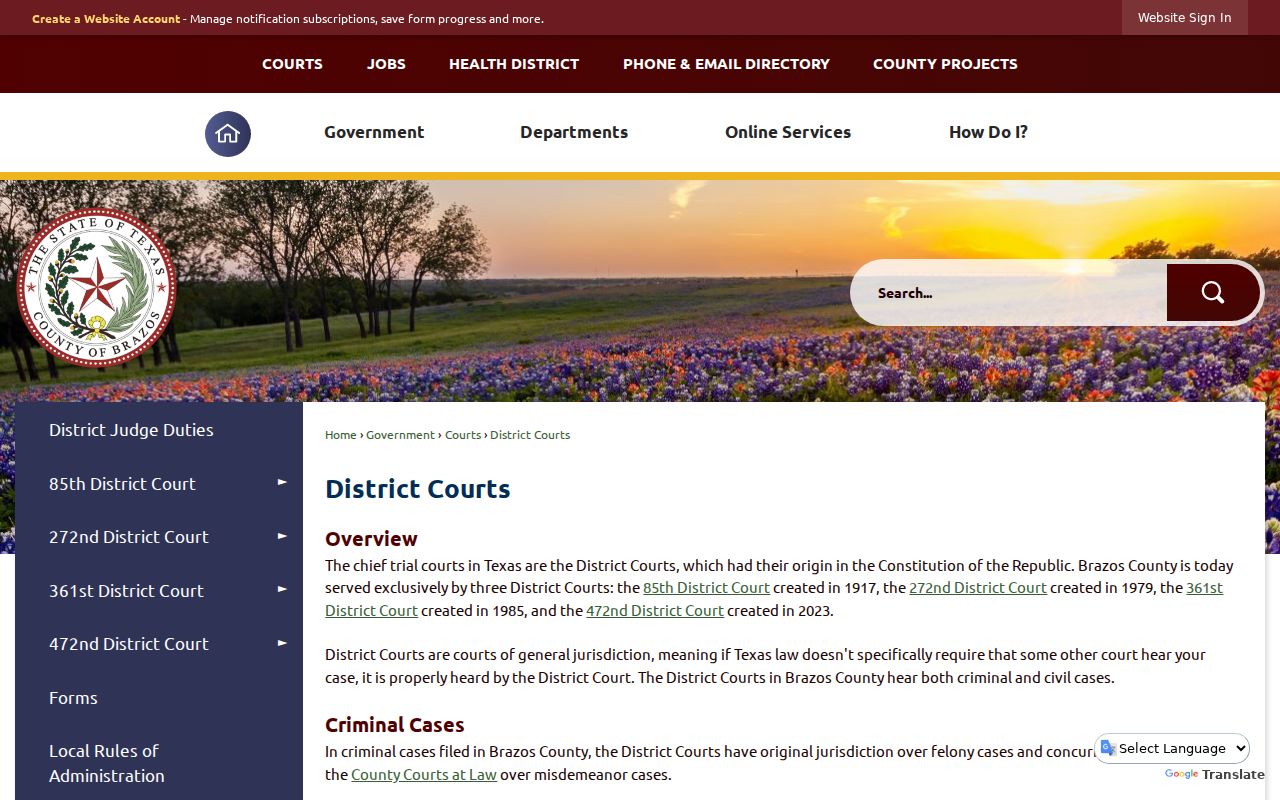
Checking the roster first to confirm the court name keeps search and copy requests from going to the wrong window.
Stages on a Criminal Docket
A criminal docket is not a single verdict line. It grows as the clerk records events. A common high-level sequence is Filing → Arraignment → Pretrial → Plea or Trial → Disposition → Sentencing. Not every Brazos County criminal case follows each step in that order. Settings may be reset, motions may be filed between events, and a plea can change the need for trial.
Docket labels each carry their own weight. An arraignment is a criminal proceeding. Its required steps vary with the court and the case. A disposition entry records how the matter ended or its resolved status. Sentencing may appear as its own event. These terms summarize what happened, but the signed judgment or order holds the controlling detail.
Motions matter between those big stages. A motion entry shows a party asked the court for something. It does not show that the court agreed. Scan ahead for a later order, hearing, or disposition entry. Then get the signed record whenever the outcome must be pinned down.
- Indictment
- A felony charging instrument issued through the grand-jury process; it is not a conviction.
- Judgment
- The court’s adjudicative order or result.
- Disposition
- The recorded resolution or status of a case or event.
- Continuance
- A postponement or rescheduling of a setting.
Brazos Criminal Activity Snapshot
Aggregate numbers give context, never facts about a person.
The OCA district activity summary was run on August 15, 2024. It covers September 1, 2022 through August 31, 2023. Its Brazos criminal columns list active pending at the start, cases added, cases disposed, and active pending at the end. Read the labels carefully. "Added" does not mean unique people. "Disposed" does not mean guilty. And "active pending" decides nothing about anyone.
For newer figures, turn to the Court Activity Reporting and Directory. Courts submit these snapshots themselves, so the reports are not a criminal docket lookup by name.
Which Court Holds Criminal Dockets
Begin with whatever court name is printed on your notice or citation. For felonies and most county-level criminal records, the Brazos County District Clerk holds the file. The office sits at 300 E 26th Street, Suites 1200 and 1201, Bryan, Texas 77803. Call (979) 361-4230. County Court at Law 1 and County Court at Law 2 each post their own Today's Docket link. So no single daily schedule covers the whole county.
JP clerks keep their precinct matters, and municipal clerks keep Bryan or College Station cases. Justice Web may not surface the paper you need. Then call the clerk for the court shown. Say whether you want inspection, a plain copy, or a certified copy. Mail and fax requests should ride the current official form.
Brazos County District Clerk
300 E 26th St, Suites 1200/1201
Bryan, TX 77803
(979) 361-4230
Confirm current hours, copy availability, and fees before visiting or mailing payment.
If a Brazos Search Fails
A blank result in a Brazos County docket search means just that. It is blank. It does not clear anyone of a criminal record. So work the basics first. Fix spelling, and make sure the last name comes before the first. Try the cause number exactly as filed, without guessing at punctuation. Widen the date range too. A case may also live in a different court than you assumed. Sort out which one. It may belong to a District Court, a County Court at Law, a JP court, or a municipal court.
Older criminal minutes are a separate story. The District Clerk points researchers to its historical Kofile collection for those. Think of that index as a finding aid, not a modern case file. The page it leads to shows how far back the criminal minute and fee-book series reach.
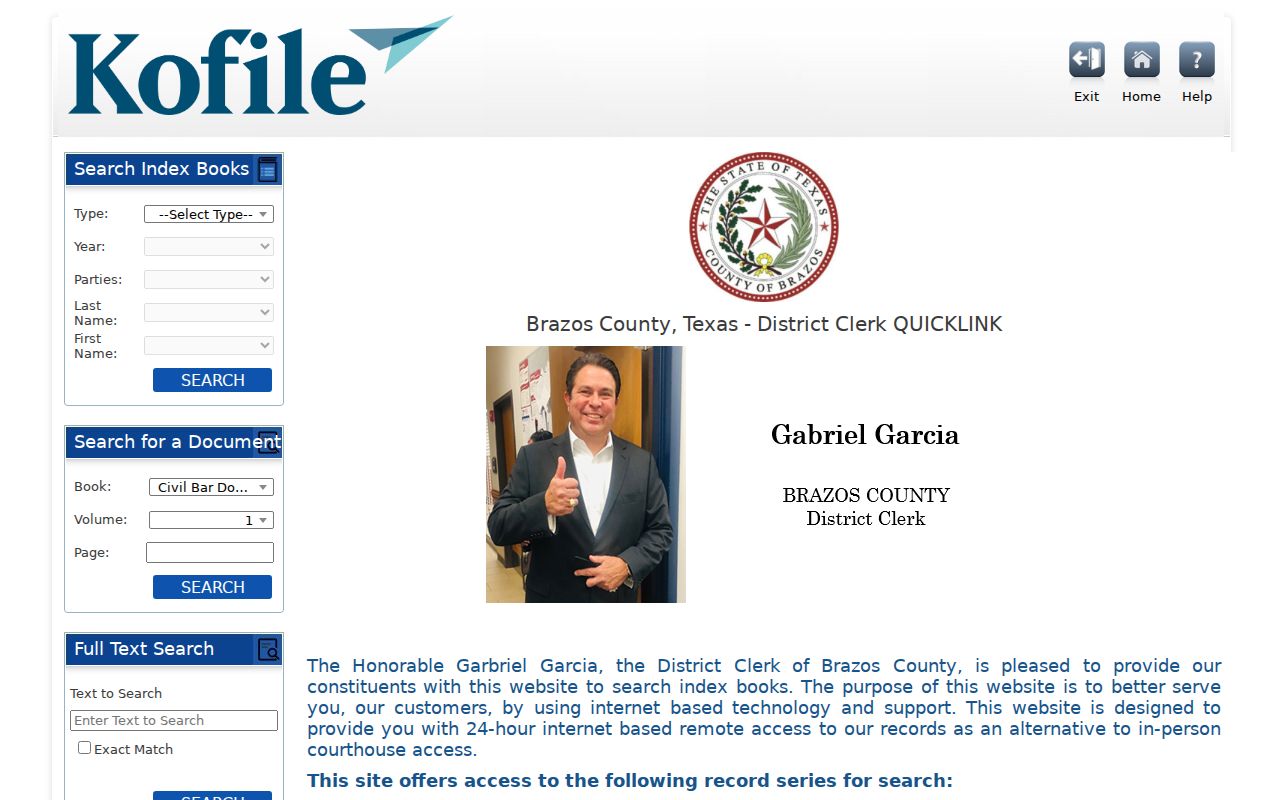
Lawful limits matter here. Juvenile files, sealed material, redacted information, and papers pulled from Justice Web each call for different handling, so ask the custodian before you push further and skip collecting sensitive data you do not need.
Public Access and Sealed Criminal Dockets
Texas does not treat every court record like an ordinary agency record under the Texas Public Information Act. Access turns on the record type. It also turns on court rules, statutes, common law, and whatever orders a judge has signed. A public docket entry can sit next to attachments that stay private. The reverse holds too. A missing online entry is not proof of sealing. Justice Web limits, indexing gaps, redaction, confidentiality law, and a sealing order are five distinct reasons a criminal docket stays out of view.
Key access rules:
Texas Rule of Judicial Administration 12 governs access to certain judicial records.
Government Code Chapter 552 directs judicial-record access to court rules and other law.
Texas Rules 21c and 76a address sensitive information and sealing.
Family Code Chapter 58 covers juvenile-record confidentiality and sealing.
Juvenile assignments go to the 272nd District Court. Access there is a different world from adult criminal access. Never request or publish protected names or identifiers. Instead, ask the clerk whether a lawful inspection or a redacted copy can be provided.
Brazos Copies and Certification
Pick the record first, then the payment channel. The District Clerk's fee page lists a $5 search request, regular or electronic copies at $1 per page, and certification at $5 plus $1 per page. Those figures can change. Confirm the current total before you send money, especially for a broad file. Certification matters. A certified copy carries the custodian's authentication, and a portal printout never gains that status just because it displays an official docket entry. The Brazos County court fee schedule helps you tell search and copy fees apart from filing fees or money owed on a case. The page lays out each category.
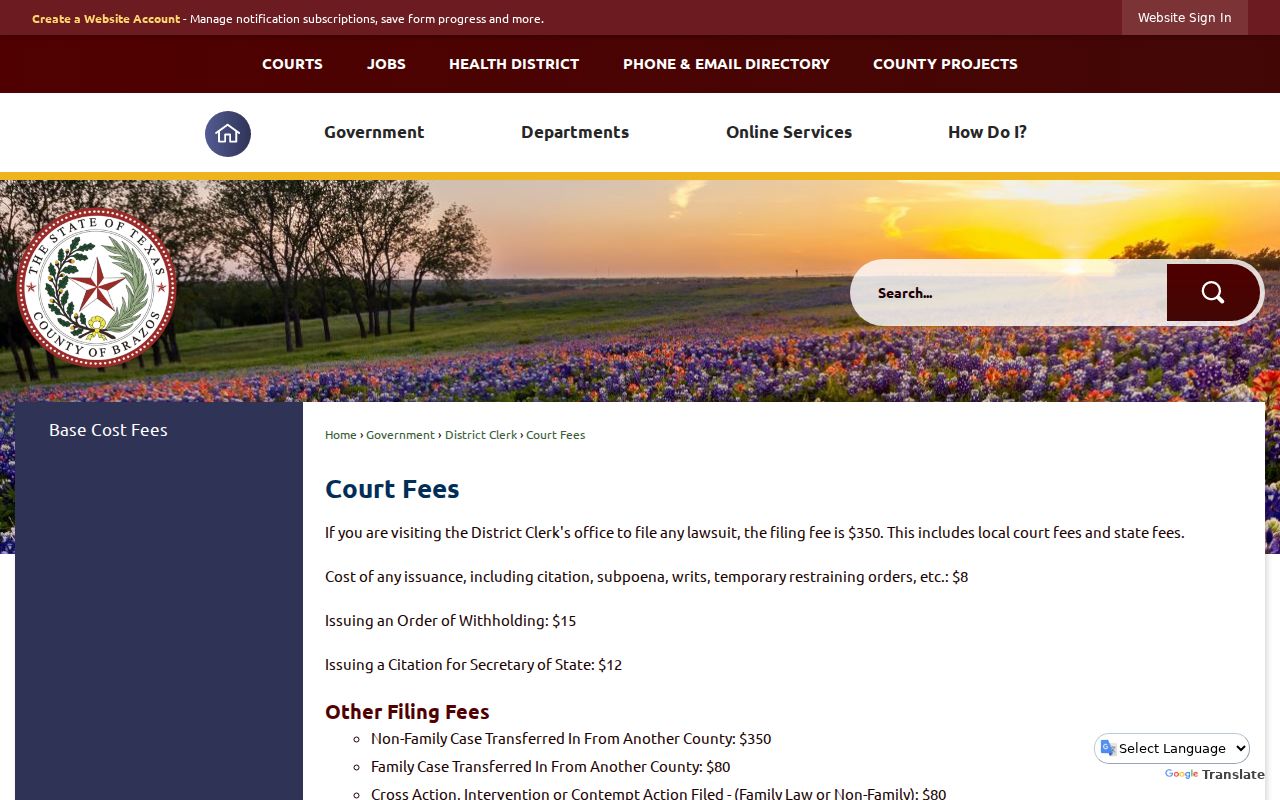
County Collections handles court balances under its own instructions. Name the document you need, then ask the clerk which payee and payment form apply.